
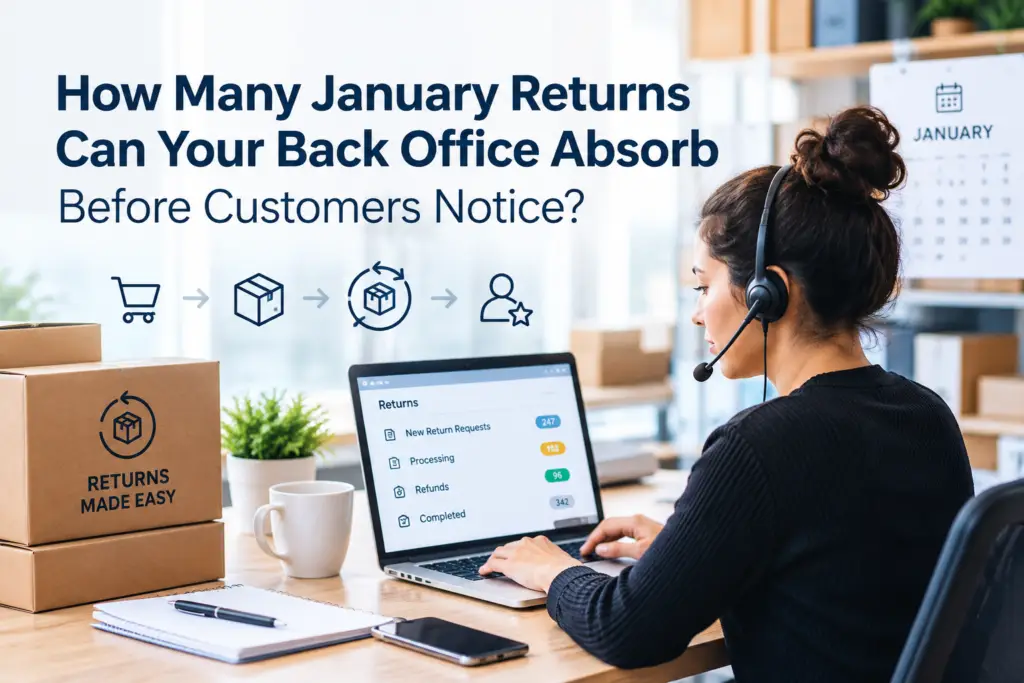
You survived Black Friday. You survived Cyber Monday. Then January hits and your inbox explodes with return requests.
If you run an e-commerce brand in the US, you know this feeling. The holiday rush is over but the return rush is just starting. So how many returns can your team really handle before shoppers start to feel the delay and post that one-star review?
We will break it down in plain language, with real numbers and a simple way to measure your limit. We will also show how back-office outsourcing services help you stay ahead without burning out your crew.
Why January Feels Like a Second Holiday Season for Your Back Office
The numbers are wild. According to the National Retail Federation, US retail returns totaled about 890 billion dollars in 2024, which was about 16.9 percent of sales. For 2025, NRF and Happy Returns forecast 849.9 billion dollars in returns at a 15.8 percent rate, with online returns running higher at 19.3 percent. That is not a small cleanup job. That is the second peak season.
And it all lands in January. Customers open gifts that do not fit. They bought two sizes to try at home. They got duplicates. Your order management system that looked fine in December now shows thousands of RMAs waiting for approval.
January is not slower. It is a return peak that can be 17 percent higher than your normal rate, so you need a plan built for volume.
For brands selling near Times Square or on Fifth Avenue in New York and shipping nationwide, that volume hits all at once. For our own teams in Kingston near the waterfront and Devon House, we see the same pattern every year with our US clients. The clock starts ticking the moment a return label is created.
What Happens When Return Volume Outruns Your Team
When your back office falls behind, customers notice fast. Here is the chain we see over and over.
- Return requests pile up in your helpdesk and your Shopify or NetSuite queue grows.
- Your agents spend more time copying order numbers and checking policies instead of actually processing refunds.
- Refund delays stretch from 2 days to 7 days to 12 days.
- Shoppers email again. They call. They ask, “Where is my money?”
- Your support ticket volume jumps 30 to 50 percent even though you are not getting new sales.
Baymard Institute found that return policy dissatisfaction drives a lot of checkout anxiety, and poor return experiences have a direct impact on loyalty. Recent roundups show customers with smooth return experiences repurchase three times more often than those who had friction.
A slow refund is not just an ops problem. It becomes a trust problem that shows up in your reviews and repeat purchase rate.
The Real Number: How Many Returns Before Customers Feel It
There is no single magic number, but you can estimate your breaking point with math you already have.
Most small- to mid-sized ecommerce back offices can process about 40 to 60 returns per person per day if that person is also doing other tasks like order entry and email support. A dedicated returns specialist can do 80 to 120 per day with good tools.
Let us say you have 3 people doing returns part-time in January. That gives you about 150 returns per day of real capacity.
Now look at your holiday sales. If you shipped 10,000 orders in November and December and your category is apparel, your return rate could be 30 to 40 percent. That is 3,000 to 4,000 returns. Most will land in the first three weeks of January. That is 200 to 270 returns per day.
You are over capacity by day two.
| Daily Return Requests | Team Capacity | What Customer Feels |
| Under 100 | Healthy buffer | Refund in 2 to 3 days, no extra contacts |
| 100 to 200 | Stretch zone | Refund in 4 to 6 days, some where is my refund emails |
| 200 to 350 | Overload | Refund in 7 to 12 days, rising complaints and chargebacks |
| Over 350 | Break point | Public reviews mention slow refunds, loyalty drops |
If your daily January returns are more than double your daily processing capacity, customers will notice within a week.
This is where brands that rely only on internal staff get stuck. Hiring in January is slow. Training is slower. By the time a new hire is ready, the surge is over.
Signs Your Back Office Is About To Break
You do not need a dashboard to feel it, but these signals tell you the breaking point is close.
- Your average time to issue a return label goes from minutes to hours.
- Your refund queue has more than 48 hours of work sitting untouched.
- Your agents start copying and pasting the same apology about delays.
- Your inventory counts in your warehouse system do not match what returns show.
- Your finance team cannot close January because credits are still pending.
If you check two or more of these, you have passed what your current team can absorb quietly.
How Back Office Outsourcing Services Keep Refunds Fast and Accurate
This is exactly what back-office outsourcing services are built for. At VLBPO, we do not just answer tickets. We build a dedicated team that lives inside your systems and handles the repetitive work that slows your core team down.
We work from Jamaica, the Philippines and Latin America with US time zone coverage. Our clients get teams that handle data entry, payment processing, order entry, inventory updates, CRM updates and claims processing. That means returns do not sit in a spreadsheet waiting for someone to have time.
Here is what we take off your plate during a January surge.
- Return authorization and label creation inside your helpdesk
- Order lookup, reason coding and fraud checks
- Refund and store credit processing in Shopify, NetSuite or your ERP
- Inventory status updates so your warehouse sees what is really coming back
- Daily reporting on how many returns were closed and what is still open
When you pair this with our e-commerce call center outsourcing team, your front office can focus on talking to customers while the back office clears the queue. No double handling. No lost RMAs.
Learn more about what we cover on our Back Office Outsourcing Services page and how we integrate with your stack.
Outsourcing returns is not about cheap labor. It is about creating a separate lane for high-volume work so your in-house team stays focused on customers.
External data backs this up. NRF notes that online return rates stay higher than overall retail, which makes a remote processing team even more valuable for e-commerce brands. And Digital Commerce 360 reported NRF expectations for 2025 returns near 850 billion dollars, showing this is not a one-year spike.
What Good Administrative Support Services Actually Do During Return Surge
Many teams think administrative support services mean inbox cleanup. In January, it means much more.
Good support does three things every day.
- Keeps data clean. Every return needs an order ID, SKU, reason code and refund amount. One typo creates a second ticket. Our teams use quality checks and automation to keep error rates low.
- Keeps systems in sync. A return touches your help desk, your ecommerce platform and your inventory. If those three do not match, you will oversell or double refund.
- Reports honestly. You need to know how many returns are still open, how long they have been open and which reasons are spiking. We build custom reports and dashboards that give you that view in real time.
Clean data and real-time visibility are what keep January from turning into March still chasing refunds.
Why Remote Back Office Support Works Better Than Adding Overtime
Overtime feels like a quick fix. In practice, it burns out your best people and still leaves gaps at night and on weekends when customers are checking refund status.
Remote Back Office Support gives you a team that is already trained on high-volume repetitive tasks and works while your US team is offline. We can launch most programs in about four weeks with pre-vetted agents, so you can ramp before peak hits. You get coverage without adding desks, laptops and managers in your office near Central Park or anywhere else.
Plus, you keep flexibility. After January, you can scale down, shift that team to order entry or catalog cleanup or keep a smaller steady crew for year-round returns.
Check our main site at VLBPO to see how we build dedicated and shared models for different growth stages.
Remote teams give you elasticity. You add capacity for the surge and you do not carry that cost all year.
A Simple Playbook To Measure Your Capacity
You do not need fancy software to run this check. Do it before December.
- Pull last January total returns and divide by 20 business days. That is your daily average.
- Count how many people touch returns and how many returns each closed per day.
- Multiply people times per person rate. That is your true daily capacity.
- If the daily average is more than 80 percent of capacity, you have no buffer.
- Add 30 percent extra buffer for fraud checks, wrong items and exchanges that take longer.
If you are already over, start talking to a partner now. Waiting until January 5 to look for help means customers will already feel it.
How VLBPO Helps Brands Stay Calm In January
We have helped e-commerce brands scale teams three times faster during peak while keeping CSAT high. Our edge is simple. We hire for fit, train for your brand voice and build processes that feel like an extension of your business, not a vendor handoff.
From our nearshore base in Kingston to US-based program management, we blend cultural alignment with real-time collaboration. Whether you need two people to clear RMA queues or a full pod that handles order entry, payment processing and reporting, we build around your KPIs.
If you are wondering how many returns you can absorb, let us run the math together and show you what a January-ready back office looks like.
Final Thought
January returns will come whether you plan or not. The question is whether your customers feel the strain. If your back office is already at 80 percent in normal months, January will push you over, and shoppers will see it in slow refunds and vague updates.
We at VLBPO help you build that buffer without adding fixed overhead. If you want a quick capacity check and a plan for peak returns, get in touch with our team today. We will map your volume and show you where you will break and build a team that keeps refunds moving even when Times Square is still lit up with holiday ads.
FAQs
How many January returns can a small e-commerce team handle?
A small team of two to three people handling returns part time can usually absorb 100 to 150 returns per day. Beyond that, refunds take a week or more and customers start to notice delays in their inbox.
What is the average e-commerce return rate in January?
For online sales, NRF reported a 19.3 percent expected return rate in 2025, higher than overall retail at 15.8 percent. Apparel and footwear can run 30 to 40 percent, which spikes heavily in January after holiday gifting.
What do Back Office Outsourcing Services include for returns?
They include RMA creation, order verification, refund processing, inventory updates, CRM data entry, claims documentation and daily reporting. At VLBPO, we also handle payment processing and supply chain support for retail clients.
How fast can Remote Back Office Support start?
Most VLBPO programs launch in about four weeks using pre-vetted agents. For January coverage, we recommend starting conversations in October or November so training and system access are ready before volume surges.
Will outsourcing returns hurt customer experience?
When done right, it improves it. A dedicated remote team clears queues faster, keeps data accurate and lets your in-house team focus on live customer conversations. Faster refunds and clear updates drive higher repeat purchase rates.