
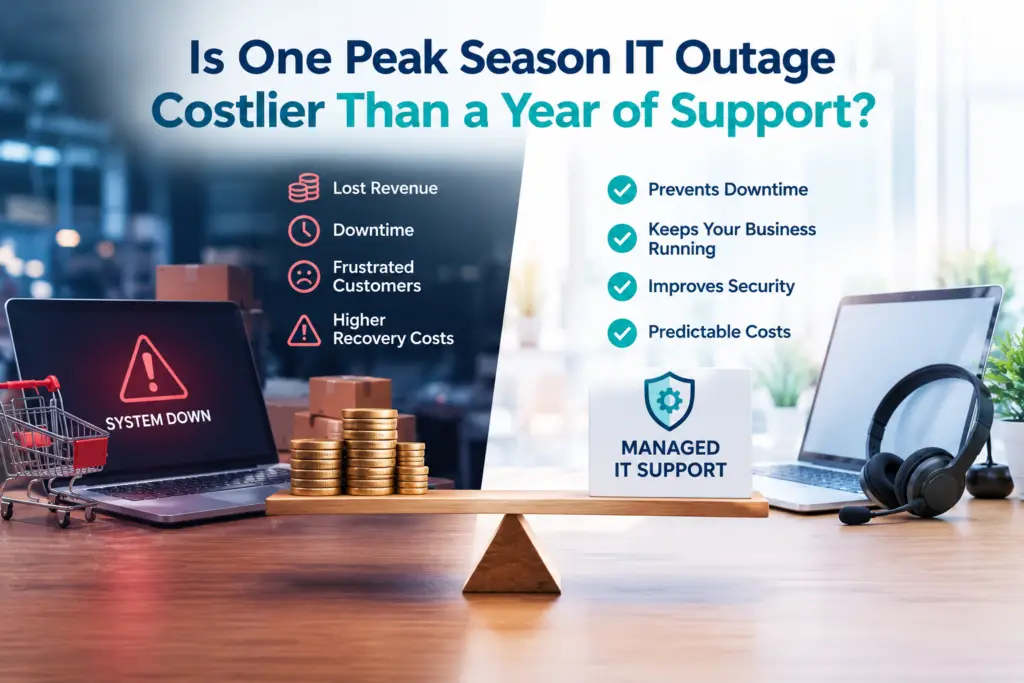
You know that feeling when your checkout page freezes right as Black Friday traffic spikes. Phones light up. Orders vanish. And your team scrambles to fix something that should have been covered months ago.
In this guide we unpack what one peak season outage really costs, why it almost always costs more than a full year of IT support services, and how we at VLBPO help e-commerce brands stay online when it matters most. If you run an online store that depends on uptime, this is for you.
What A Peak Season Outage Really Costs Your Ecommerce Store
Peak season is not just busy. It is concentrated risk. A single hour during normal days might be a small bump. The same hour during Black Friday or Cyber Monday can hold five to ten times your average hourly revenue.
For top e-commerce sites, the numbers get brutal fast. Gremlin tracks that Amazon can lose more than 220,000 dollars for every minute its main site is down, which is more than 13.2 million dollars per hour. You do not need to be Amazon for that math to hurt. If you do 50,000 dollars a day at peak, one failed checkout hour is more than 2,000 dollars in lost sales that rarely come back.
Peak season makes every minute of downtime worth more because demand is compressed into a short window.
When we talk to e-commerce leaders, we hear about three hidden costs that hit harder than the lost order total.
- Immediate revenue loss from failed payments and abandoned carts
- Recovery costs for overtime, emergency fixes, and support tickets
- Long tail costs from refunds, negative reviews, and lower repeat purchase rates
That last one is what most brands miss. A shopper who hits an error during a gift-buying rush does not wait. They buy from a competitor.
Why Gartner And ITIC Numbers Should Make You Pause
We like to ground this conversation in current benchmarks, not old myths.
Gartner is still widely cited for an average cost of 5,600 dollars per minute, which translates to about 336,000 dollars per hour. That figure is from 2014 but remains the baseline many boards use.
Newer data shows the reality is steeper. ITIC found in its 2024 survey that more than 90 percent of mid-sized and large enterprises now lose more than 300,000 dollars per hour, and 41 percent lose between 1 million and 5 million dollars per hour.
Retail is not spared. New Relic surveyed 147 retail and consumer technology leaders and found the median hourly cost of a critical business outage for retailers stands at 1 million dollars. That is not a tech company problem. That is a retail problem.
Uptime Institute adds another lens. Its Annual Outage Analysis reports that 57 percent of data center operators say their most recent major outage cost more than 1 million dollars.
Even if your store is smaller, the pattern holds. Hourly costs have climbed well past six figures for most online businesses.
The True Math: One Hour Down Versus One Year Of IT Support Services
Let us put simple numbers on the table. We will use conservative retail numbers, not enterprise extremes.
| Cost Area | One Hour Peak Outage | One Year Of Managed IT Support Services With VLBPO |
| Lost sales in peak hour | 5000 to 50000 dollars depending on store size | Covered by proactive monitoring |
| Emergency fix and overtime | 1000 to 8000 dollars | Included in flat monthly plan |
| Support ticket surge | 500 to 3000 dollars in extra agent time | Handled by our 24/7 IT Help Desk Support |
| Refund and chargeback risk | 2 to 5 percent of affected orders | Reduced by faster resolution |
| Brand trust and repeat purchase | Hard to measure but real churn | Protected by consistent uptime |
| Total exposure | Often 7000 to 60000 dollars in one hour | Often less than that for a full year |
For many e-commerce brands we support, a full year of managed IT support services costs less than the fallout from a single bad hour in November or December.
If you are searching for IT support services near you in Missoula near Caras Park and the University of Montana corridor, or IT support services near you serving customers close to Times Square and Midtown Manhattan, the math looks the same. Peak demand magnifies downtime.
One hour can cost more than twelve months of prevention.
What Breaks During Peak Season That Managed IT Support Services Prevent
Peak season failures are rarely exotic. They are predictable.
- Checkout and payment gateway timeouts under load
- Inventory sync errors between Shopify, WMS, and ERP
- CDN or DNS misconfigurations after a quick promo update
- Help desk overload when password resets and order status tickets spike
- Fraud filters that block legit buyers when rules are too tight
Our managed IT support services focus on stopping these before they become outages. We run pre-season load tests, we audit third-party scripts that slow page loads, we set up real-time alerts for error rate spikes, and we keep runbooks ready so a junior agent does not have to guess during a rush.
If you want to see how this fits with front office coverage, look at our ecommerce call center outsourcing program. It pairs IT support with customer-facing teams so technical fixes and customer updates happen together. For US-based coverage, our USA call center outsourcing page shows how we staff onshore teams from our base at 127 N Higgins Ave in Missoula, MT, with nearshore centers in Kingston, Jamaica, and LATAM to follow the sun coverage.
Most peak season outages are not code mysteries. There are capacity and coordination gaps that managed support closes.
How 24/7 IT Help Desk Support Keeps Revenue Flowing
The difference between a five-minute blip and a sixty-minute outage is usually how fast a human picks up.
Our 24/7 IT help desk support model is built for e-commerce. That means we do not just log a ticket and wait until morning. We triage by revenue impact. Checkout down gets instant escalation. A low-priority report bug waits.
What that looks like in practice for VLBPO clients.
- Constant monitoring of site health, payment flow, and order queue
- Immediate isolation of the failing piece, whether it is app, host, or integration
- Clear customer communication scripts so your shoppers hear a helpful update, not silence
- Post-incident review with root cause and a fix that prevents repeat
We also integrate with your existing stack. Whether you use Zendesk, Salesforce, or Five9, our teams plug into the same queues your agents use. That way IT and customer care move as one.
If you are comparing IT support services near you, ask about the mean time to acknowledge and mean time to resolve during peak hours, not just business hours. Those two metrics decide whether you lose ten orders or a thousand.
Round-the-clock help desk support turns a potential hour-long outage into a quick recovery story.
Real Example From Missoula To Manhattan
Picture two stores. One is a growing apparel brand run from Missoula close to downtown near Higgins Avenue. The other is a beauty brand with most customers near Times Square and Soho. Both do about 30,000 dollars on a normal day and triple that during peak.
Without managed support, both hit the same wall on Saturday of Black Friday weekend. A third-party review widget pushes a bad update. Product pages load slowly, then payment starts timing out. It takes 42 minutes to notice because alerts went to an email no one watches on weekends. It takes another 38 minutes to rollback because no one has access. The total outage is 80 minutes. At peak rate, that is about 8,000 dollars in lost sales plus 1,500 dollars in overtime and 400 dollars in refunds. And that is before you count the shoppers who never return.
With managed IT Support Services from VLBPO, the alert fires in two minutes, the on-call engineer rolls back the script in eight, and the help desk posts a status update to chat and email. Total impact is under fifteen minutes. Same traffic, fraction of the cost.
We see this pattern often with brands that scale from ten agents to forty during peak. Our teams are built to scale up and down fast, which is why clients mention peak flexibility in reviews on our homepage at VLBPO.
The cost difference is not theoretical. It shows up in your Stripe dashboard the next morning.
Where VLBPO Fits In Your Peak Season Plan
We are not an extra vendor layer. We act as an extension of your team, with dedicated agents who learn your brand voice and your tech stack.
Here is what we bring when you outsource IT support services to us.
- Proactive coverage that includes patching, monitoring, and capacity planning
- Onshore US expertise with nearshore cost advantage from Jamaica, the Philippines, and LATAM
- Combined front office and back office support so IT fixes and customer updates stay aligned
- Playbooks for peak that we rehearse before November, not during it
- Reporting that ties uptime to revenue, so you can show the board why managed support pays
Our headquarters is in Kingston with delivery centers across Jamaica, the Philippines, and Latin America, plus our US office in Missoula. That mix gives you US time zone coverage without US overhead and access to English- and Spanish-speaking talent for your shoppers near you, whether that shopper is near Central Park or near Caras Park.
You get prevention, fast recovery, and customer-facing coordination in one partner.
How To Calculate Your Own Risk In Five Minutes
You do not need a complex model to estimate your exposure.
- Take your average hourly revenue during peak last year. If you did 60,000 dollars per day, that is about 2,500 dollars per hour on average, but peak hours might be double.
- Multiply by your estimated outage duration. Be honest. If last year a fix took an hour, use an hour.
- Add emergency labor. One engineer on a weekend call can be 150 to 250 dollars per hour. Two agents handling tickets can be another 100.
- Add refund and reship cost. Even 3 percent of affected orders adds up.
- Compare that total to a yearly quote for managed IT support services.
Most brands find that even one incident covers the annual support cost. Two incidents make it an easy decision.
If you want help with the math, we will walk through it with your real numbers and show where IT support services near you can trim risk fastest.
Final Check Is Managed Support, The Safer Bet
A single peak season outage is more than an IT issue. It is a revenue, trust, and team morale issue. The data from Gartner, ITIC, New Relic, and Uptime Institute all point the same way. Outage costs have risen sharply and retail remains exposed during high-traffic events.
Managed IT support services from VLBPO costs a fraction of that exposure and gives you proactive monitoring, 24/7 IT help desk support, and a team that knows how e-commerce breaks in November.
If one hour can cost more than a year of protection, protection is not an expense. It is insurance for your busiest days.
Ready to make peak season boring in the best way. Talk to us. Visit our ecommerce call center outsourcing page to see how we pair IT and customer care, or get in touch at hello at VLBPO and tell us about your peak season setup. We will map your risk, show where IT support services near you can help, and build a plan that keeps your checkout running whether your customers are shopping near Times Square, near Pike Place, or near our home base in Missoula.
FAQs
What do IT Support Services include for e-commerce brands near Missoula and across the US?
We cover monitoring, incident response, help desk, system administration, and integration support for Shopify and other stacks. For brands near you in Missoula and nationwide, we add peak playbooks and real-time escalation so checkout stays up.
How are Managed IT Support Services priced compared to an outage?
Most brands pay a flat monthly fee that is less than one hour of peak outage loss. ITIC data shows many firms lose 300k plus per hour and New Relic shows a retail median of 1 million per hour, so yearly managed support is often far cheaper.
What makes 24/7 IT Help Desk Support different from regular business hours support?
Peak issues do not wait for Monday. Our 24/7 IT help desk support triages by revenue impact, provides instant rollback help, and keeps customer messaging consistent, which reduces ticket backlog and repeat contacts.
Can VLBPO support stores that sell near major landmarks like Times Square or Central Park??
Yes. We support US brands serving shoppers near Times Square, Central Park, Caras Park, and other high-traffic zones. Our US-based team in Missoula plus nearshore centers gives you follow-the-sun coverage without time zone gaps.
How fast can VLBPO get started before peak season?
Most programs go live in about two to four weeks using prevented agents. We recommend starting at least six weeks before Black Friday so we can run load tests and build your peak runbook.