
It is 9:40 on a Saturday night in Missoula. A mom has a toddler with a rising fever, and she is calling the one clinic she trusts. Does a real person pick up, or does a recording tell her to call back Monday?
That single call can decide whether she stays with your practice for the next ten years. Plenty of Montana clinics still cover these moments with a shared phone, a voicemail box, or a worn-out front desk team. A medical answering service offers a different path. So does building your own night shift.
At VLBPO, we help practices weigh both options all the time. In this guide, we compare real costs, hidden risks, and the point where each choice makes sense. By the end, you will know which one fits your clinic.
Key Takeaways
- A medical answering service usually costs less than staffing nights, weekends, and holidays with your own people.
- One 24/7 phone seat takes about 4.2 employees, because a week has 168 hours and one full-time worker covers about 40.
- Patients leave after poor communication. A 2024 Smart Communications survey put that share at 69%.
- A hybrid setup often works best. Your clinicians handle urgent triage, and an outside team handles routine calls.
What Is the Difference Between a Medical Answering Service and In-House Coverage?
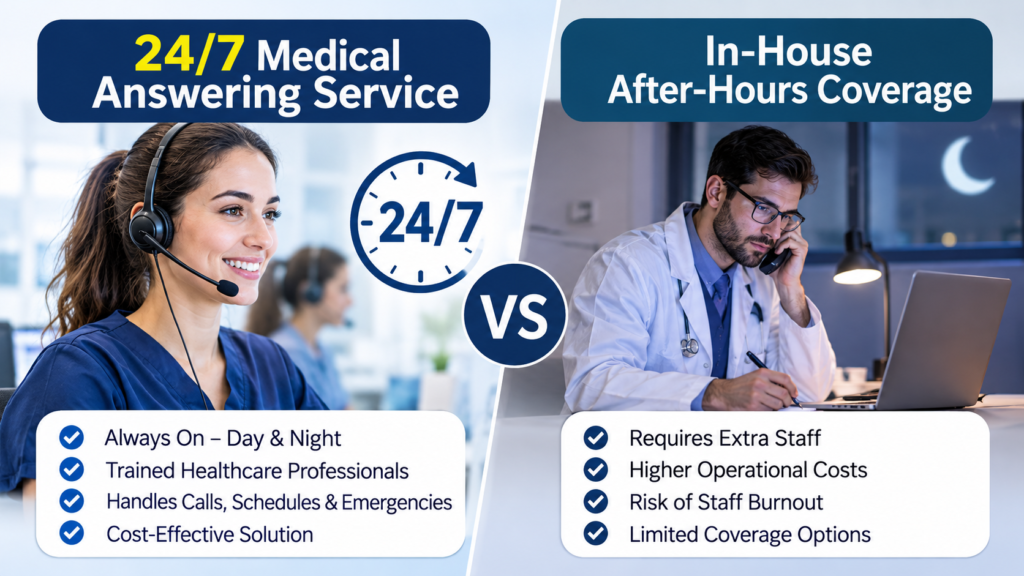
A medical answering service is an outside team that answers patient calls when your office is closed. In-house coverage means your own employees or mid-sized physicians handle those calls. The core tradeoff is cost and reliability against direct control. Most small and mid-sized practices get steadier coverage for less money with an outside team.
Both models can work. The right pick depends on your call volume, your budget, and how many people you can spare at 2:00 a.m.
Why Do After Hours Calls Matter So Much in Missoula and Across Montana?
Health problems do not follow office hours. In Missoula, the caller might be a University of Montana student with a bad case of the flu. It could be a hiker back from the M trail on Mount Sentinel with a swollen ankle. It could be a parent near Caras Park who is worried about a fever.
Distance makes things harder. The Montana Department of Public Health and Human Services notes that 51 of the state’s 56 counties count as rural. A patient in the Bitterroot Valley may face a long drive to Providence St. Patrick Hospital or Community Medical Center. A calm, informed phone answer can save that trip or confirm it is worth making.
Patients also expect quick replies. A 2024 Smart Communications survey found that 69% of healthcare consumers would switch providers if communication missed their expectations. A missed after-hours call is a quiet reason patients leave. We cover the retention side in our post on how after-hours calls quietly destroy patient retention.
What Does In-House After-Hours Coverage Really Cost?
Covering nights and weekends sounds easy until you do the math. A week has 168 hours. One full-time employee works about 40 of them. So one 24/7 phone seat takes roughly 4.2 people.
The Bureau of Labor Statistics reports a median annual wage of $47,460 for secretaries and administrative assistants as of May 2024. Multiply that by 4.2, and you reach about $199,000 in base pay for a single seat. That number leaves out payroll taxes, benefits, training, and overtime.
Hidden costs pile up fast:
- Sick days and vacations that leave gaps in coverage
- Night shift pay differentials and higher turnover
- Training on triage scripts, HIPAA rules, and your EHR
- Phone lines that jam during flu season or after a holiday weekend
Some practices skip the extra hires and lean on an on-call clinician. That choice has a price too. The AMA found that 20.9% of physicians spent more than eight hours a week in the EHR outside normal work hours, based on 2023 survey data. Adding midnight phone duty on top of that load invites burnout.
How Does a 24/7 Medical Answering Service Work?
Think of a medical answering service as a night shift you do not have to hire. Trained agents answer under your clinic’s name, follow your scripts, and pass urgent issues to your on-call provider. Here is the usual flow:
- A patient calls your main number, which forwards to the service after hours.
- A live agent greets the caller and asks a few set questions.
- Urgent symptoms go straight to your on-call clinician using your triage rules.
- Routine needs, like booking, refills, or billing questions, get handled or logged.
- You receive a clear summary before the doors open.
The best services close the loop instead of just taking messages. At VLBPO, our healthcare teams include RNs and operations experts. We run SOC 2 Type 2 and HIPAA-compliant operations, and most programs go live in about four weeks. You can see the full list of services on our healthcare BPO page.
Language matters here as well. Many clinics serve Spanish-speaking families, and a phone tree that only speaks English loses them. Our multilingual call center teams cover English and Spanish around the clock.
Medical Answering Service vs. In-House Coverage: Side by Side
This table shows how the two models compare on the points clinics ask about most.
| Factor | 24/7 Medical Answering Service | In-House After-Hours Coverage |
|---|---|---|
| Cost model | Usually a monthly plan based on call volume or agent hours | About $199,000 in base wages for one 24/7 seat, before benefits |
| Coverage gaps | Nights, weekends, holidays, and overflow are covered | Sick days and vacations create holes |
| Speed to launch | Often about four weeks with VLBPO | Months to recruit and train |
| Triage quality | Scripted protocols, with RN support available | Varies with whoever is on shift |
| Scaling | Flexes up for flu season spikes | Fixed headcount |
| Compliance | Signed BAA and audited controls | You own every control |
| Control | Shared, guided by your scripts | Full direct control |
| Clinician burnout | Fewer 2:00 a.m. interruptions | Heavier on-call load |
Costs vary by call volume and contract. In our healthcare work, clients have saved up to 50% compared with building the same coverage in-house.
When Does In-House Coverage Still Make Sense?
We want to be fair here. An outside team is not right for every clinic. In-house coverage can fit when:
- You run a hospital-based program with a nurse line already staffed around the clock
- Your after-hours volume is tiny, and your on-call clinician rarely gets a call
- Every call demands clinical judgment, such as active oncology care
Even then, a hybrid model deserves a look. Let your clinicians own the urgent line. Let an outside team take scheduling, refills, billing questions, and message taking. In our experience, about 70% of after-hours calls are administrative. Moving those calls off your clinicians protects their sleep and your schedule.
What Should You Ask Before Hiring a Medical Answering Service Near You?
Searching for a medical answering service near you in Missoula, Billings, or Bozeman is a fine start. But location alone says little about quality. Hours, training, and security matter more. Ask every provider these questions:
- Will you sign a business associate agreement? HIPAA generally requires one when a vendor handles patient data for you. HHS publishes sample business associate agreement provisions you can compare against.
- Do your agents work Mountain Time hours?
- Can you connect to our EHR and scheduling tool?
- How do you handle emergencies and escalate to our clinicians?
- Do you offer Spanish coverage?
- What reports will we see each month?
Also tell the provider where your patients go in an emergency. That might be Providence St. Patrick Hospital in Missoula, Billings Clinic, or Bozeman Health Deaconess Hospital. Agents should know your handoff rules by heart.
For context, our U.S. sales office sits on North Higgins Avenue in downtown Missoula, near the Clark Fork River. Our nearshore teams in Jamaica and Latin America work U.S. hours.
How Do You Choose? A Five-Step Test
- Log every after-hours call for 30 days.
- Sort them into urgent, routine, and administrative.
- Price a full 24/7 seat with the 4.2 person rule.
- Ask two outside providers for quotes.
- Run a 60-day pilot. Track missed calls, wait times, and your morning backlog.
If your urgent calls are rare and your administrative calls are many, an outside team often wins on cost. If urgent calls dominate, a hybrid plan keeps your clinicians in charge where it counts.
Ready to Close the After Hours Gap?
A missed call at night is more than a missed call. It is a patient deciding whether your clinic is there for them. A medical answering service gives you steady coverage without the cost of a full night shift. In-house teams give you control but carry high cost and burnout risk. For many Montana practices, the hybrid path hits the sweet spot.
If you want help sizing the right setup, we are glad to talk it through. Get in touch with VLBPO or call us at +1 (757) 936-8514. We will review your call volume, your EHR, and your budget, then map out a plan that fits.
FAQs
What Is a Medical Answering Service?
A medical answering service is a team that answers patient calls when your office is closed. Agents take messages, book visits, and route urgent issues to your on-call provider under HIPAA rules, so patients reach a real person.
How Much Does a Medical Answering Service Cost Compared With Hiring Staff?
Pricing depends on call volume and features. Covering one 24/7 seat in the house takes about 4.2 employees, or nearly $199,000 in base wages alone. An outside service usually costs less because you share the team with other clinics.
Is a Medical Answering Service HIPAA Compliant in Montana?
It can be. HIPAA is a federal rule, so it applies in Montana. Ask for a signed business associate agreement, staff training records, and encryption details before sharing any patient information with an answering service.
Is There a Medical Answering Service Near Me in Missoula?
Local reach matters less than hours and training. VLBPO has a U.S. sales office in downtown Missoula, and our nearshore teams work U.S. hours and can support clinics across Montana, from Kalispell to Billings.
Can a Medical Answering Service Schedule Appointments and Speak Spanish?
Yes, many can. Agents connected to your scheduling tool can book, change, or cancel visits on the spot. At VLBPO, we cover English and Spanish around the clock, so more patients get help in their language.